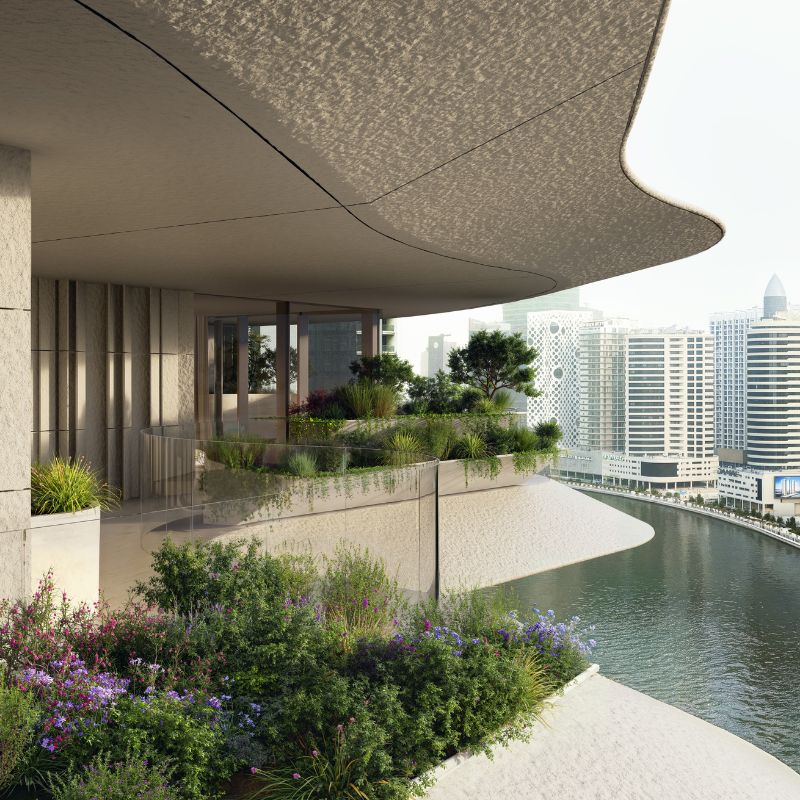



Wedyan is “like a mountain, slowly stepping down into the sea.”
This is the image Kengo Kuma imagines when he describes Wedyan: a conversation between land and water, where architecture cascades and descends to eventually become part of the landscape itself. It is also what Sultan Al Ghurair speaks about in his vision: a building should have a relationship with the environment around it. Not simply occupy a site, but belong to it.
A dialogue with its environment
Wedyan sits on the bend of the Dubai Water Canal near Business Bay, DIFC and Downtown Dubai. It is a rare piece of ground in the city’s centre, along a waterfront promenade.
The Dubai Water Canal is the 3.2 km waterway that connects Business Bay to the Arabian Gulf, threading a new realm of living through the heart of the city. It is the 6.4 km of promenade that now draw residents, cyclists, runners and diners along the canal’s edge. It is the skyline of Business Bay and Downtown Dubai rising behind it, and the shorter horizon of Jumeirah and the sea beyond.
Wedyan is shaped in response to the canal. The curves of the façade descend in layers, with each terrace changing its shape and taking new forms at every level until the lower canopies seem to meet the waters and the ground dissolves into the community. The planting, curated by Gustafson Porter + Bowman, is a vertical ecosystem rather than a cosmetic layer: desert-tolerant trees, shrubs and flowering species that trace the building from ground to sky. Even the ground floor, with its permeable colonnade and shaded walkways, invites the promenade to continue through the building rather than around it.
Leaning toward the water. Listening to the city. A mountain slowly stepping down into the sea. Wedyan is a building in conversation with its environment. This is what it is designed to be.